What Did the Smoke Detector Test Actually Prove?
Magnet tests, smoke-entry tests, and sensitivity testing are not the same thing. Three questions can each get you a “PASS” on the test sheet — and three very different answers about what your detectors will actually do.
“We tested all the smoke detectors.”
— A line every technician has said, and every technician has heard
It doesn’t say how. And how changes everything you actually know.
There is a phrase most of us who have worked around fire alarm systems have heard countless times: “We tested all the smoke detectors.”
That sounds simple enough.
But my next question would be: how did you test them?
Did you put a magnet against the detector? Did you introduce smoke or test aerosol? Did you measure the detector’s sensitivity?
All three might cause someone to say, “The detector passed.”
But they don’t prove the same thing. And understanding that difference is important.
The magnet test

Let’s start with the magnet.
If you’ve been in the fire alarm industry for a while, magnet testing didn’t come out of nowhere. Manufacturers actually used it.
One example from my earlier years in the trade is the Simplex 2098-9201 photoelectric smoke detector. Simplex documentation from the early 1990s identified several different pieces of test equipment for the 2098 series:
- an extendable smoke generator,
- a dedicated sensitivity tester, and
- a test-and-removal tool that could be used to place the detector into alarm.
The manufacturer’s instructions identified smoke as the preferred functional test. But when that wasn’t practical, the test-and-removal tool could also be used to alarm the detector.
So when an experienced technician says, “We’ve always tested detectors with magnets” — there really is some history behind that practice.
What has changed is our understanding, and the requirements, of what a functional smoke detector test is supposed to demonstrate.
Today, simply making the detector report an alarm does not demonstrate everything we need to know.
A magnetic test feature might prove that some of the detector’s electronics are functioning. It might prove the detector can communicate an alarm condition to the fire alarm system.
Those can be useful things to know.
But there is one very important thing it does not necessarily prove: that smoke can get into the detector.
The smoke has to get inside
For system smoke detectors, NFPA 72 (National Fire Alarm and Signaling Code)’s functional testing method is intended to demonstrate that smoke enters the sensing chamber and produces an alarm response.
That physical path matters. Think about what we are actually trying to prove:
Smoke in the protected area → enters through the detector openings → reaches the sensing chamber → is detected → produces an alarm response.
A magnet bypasses part of that process.
That’s why current NFPA 72 material specifically identifies magnets as unacceptable for the smoke-entry portion of the test.
And there is a practical reason for that.
Imagine a detector that still has a construction dust cover installed. Or a detector whose openings have become obstructed by dirt, paint, contamination, or years of environmental buildup.
It might respond perfectly to a magnet.
But would smoke from the room actually get into the sensing chamber? That’s the part we need the functional smoke test to prove.
So we “smoke” the detector
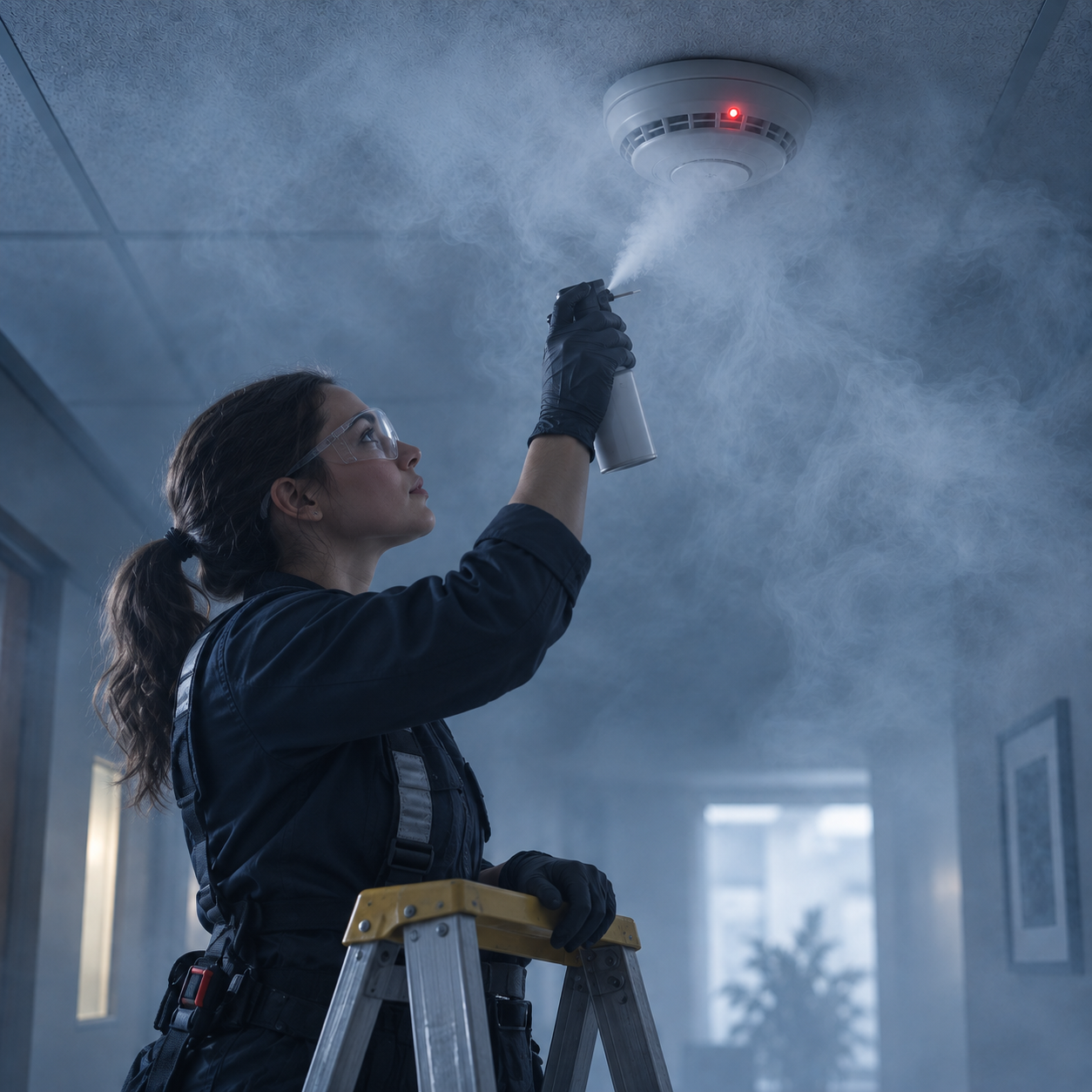
That brings us to another expression technicians use: “smoke the detector.”
We introduce smoke or an appropriate test aerosol and wait for the detector to alarm. Pretty simple.
Except I’ve seen this happen: spray. Nothing. Spray again. Still nothing. A little more. Wait. Another spray.
Eventually there is so much aerosol hanging in the air that the room starts taking on a blue haze.
Then finally: alarm. The detector goes into alarm. The technician records: PASS.
But should that be the end of the conversation?
Technically, we may have demonstrated something important. Smoke entered the detector’s sensing chamber and the detector eventually produced an alarm response. That’s the purpose of the functional test.
But we haven’t answered another equally important question: how much smoke did it take?
That’s where sensitivity comes in
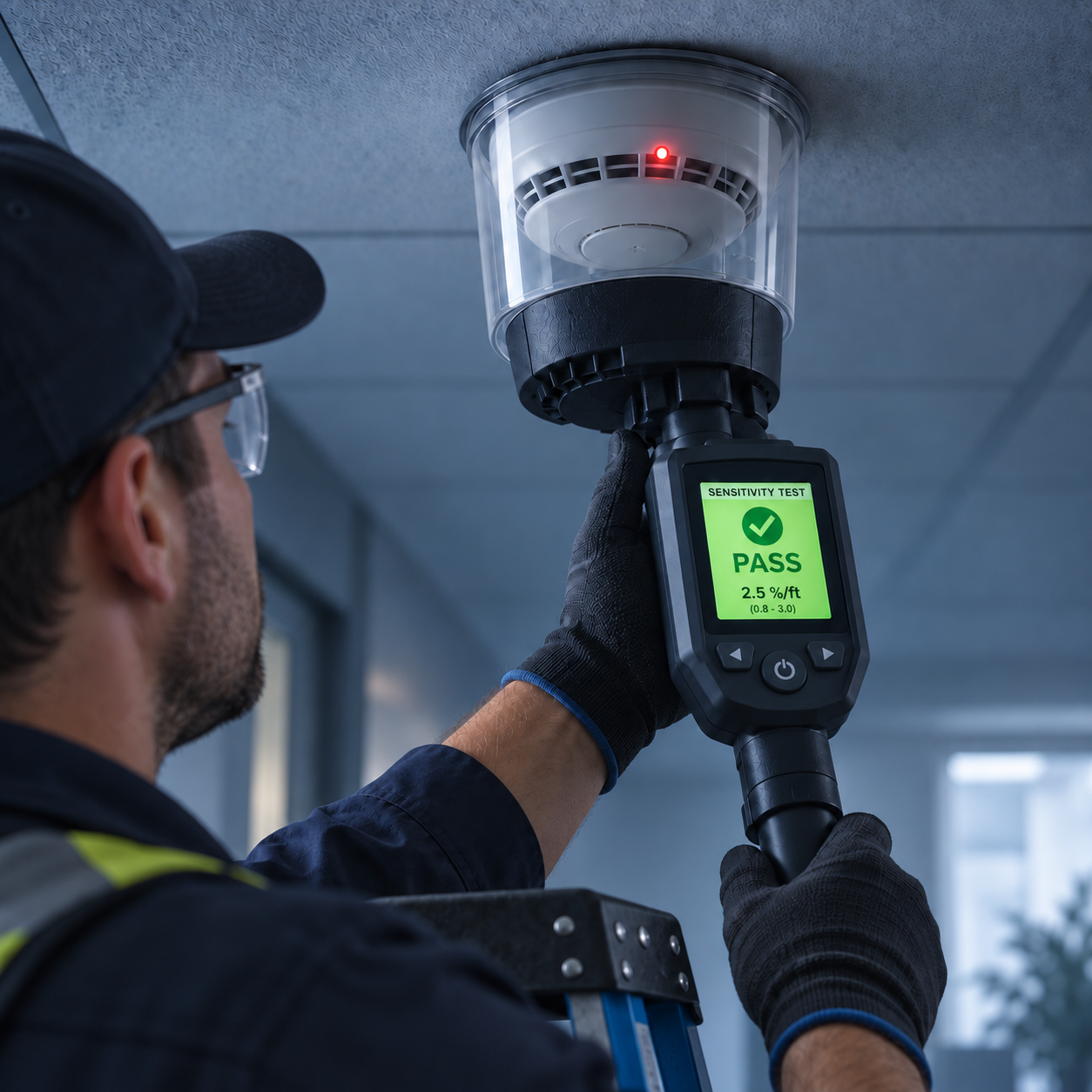
Functional testing and sensitivity testing are two different things.
A functional smoke test asks: can smoke enter the detector and cause it to alarm?
A sensitivity test asks: is the detector responding within its listed and marked sensitivity range?
Those are very different questions.
The detector in our smoke-filled room might eventually alarm. But if it took an excessive concentration of smoke to get there, simply writing “PASS” on the functional test doesn’t tell us whether that detector is still operating at the sensitivity at which it is supposed to operate.
That requires sensitivity testing.
You can’t measure sensitivity with “more smoke”
This distinction is important enough that NFPA 72 addresses it specifically.
Detector sensitivity is not determined by using equipment that simply introduces an unmeasured amount of smoke or aerosol into the detector.
That makes sense. If I spray some aerosol toward a detector, I don’t know what concentration actually reached the sensing chamber. If it doesn’t alarm and I spray some more, I’ve changed the concentration again. If I keep spraying until it finally alarms, I have demonstrated functional response. I have not measured its sensitivity.
“It eventually alarmed.” Versus: “It alarmed at 2.5 percent-per-foot obscuration and is within its listed sensitivity range.”
One is a functional observation. The other is a measurement.
Sensitivity testing has its own requirements
For system smoke detectors in occupancies other than one- and two-family dwellings, NFPA 72 establishes a separate sensitivity-testing program.
The basic framework includes checking sensitivity within the required period following installation and at prescribed intervals afterward.
Where testing demonstrates that detectors remain within their listed and marked sensitivity ranges, NFPA 72 permits the interval to be extended under specified conditions.
The important point for this Field Note isn’t memorizing the interval. It’s recognizing that:
The annual functional test does not replace the required sensitivity test. And the sensitivity test does not replace the functional smoke-entry test. They are looking for different things.
Three questions, three different answers
This is probably the simplest way I know to explain it.
1. Can I make the detector produce an alarm?
A manufacturer’s internal test feature, electronic command, magnet, or similar method might answer that question. It can tell us useful information about portions of the detector and system. But by itself it does not prove smoke entry.
2. Can smoke from the protected area enter the detector and cause an alarm?
That’s what the functional smoke-entry test is intended to demonstrate. Smoke, or a listed and labeled product acceptable to the manufacturer, is introduced so the detector actually has to detect something entering its sensing chamber.
3. Is the detector responding at the proper concentration?
That’s sensitivity testing. Now we’re determining whether the detector remains within its listed and marked operating range.
Three questions. Three different pieces of information.
And that is why simply saying, “The smoke detectors were tested,” doesn’t always tell the whole story.
A little more history from the field
There is another testing story from years ago that I still remember.
At the time, Simplex was very particular about the products technicians introduced into their detectors. My recollection was that there was concern about using certain canned test aerosols directly on the detectors, including possible effects from the aerosol or propellant.
I haven’t been able to locate the old manufacturer documentation establishing the exact reason, so I’m intentionally presenting that part as my recollection rather than as a current manufacturer requirement.
But I definitely remember one contractor’s solution.
He carried a metal can with him — something about the size of a large food can. Instead of spraying his test aerosol directly into the detector, he sprayed it into the can. Then he raised the can over the smoke detector.
Essentially, he created a small chamber containing test smoke and allowed the detector to respond to the smoke inside it without directly spraying aerosol into the detector.
Was it today’s sophisticated detector-testing equipment? Absolutely not.
But think about what he was trying to accomplish. He wanted smoke to enter the detector while controlling how the product was introduced.
Today’s testing tools are much more refined. We have purpose-built detector test cups, aerosol delivery systems, calibrated sensitivity instruments, and in some systems electronic sensitivity information provided by the detector and control equipment.
The equipment has changed considerably. But the underlying question hasn’t: what are we actually proving with the test?
More smoke doesn’t make it a better test
This may be the biggest takeaway from the whole discussion.
When a detector doesn’t respond immediately, the natural reaction can be: give it some more smoke. And then some more. Eventually it alarms. Done.
But when we’re standing in a visible cloud of test aerosol waiting for a detector to finally operate, maybe that’s the moment to stop thinking only about whether it eventually alarms.
Maybe we should be asking: why did it take that much?
That question is where functional testing and sensitivity testing meet.
The functional test tells us that smoke can enter the sensing chamber and cause the detector to operate. The sensitivity test helps tell us whether the detector is still responding where it is supposed to.
Both matter.
So… did the detector pass?
Maybe.
But before answering that question, I’d want to know what test was performed.
If you used a magnet: what did the magnet prove?
If you introduced smoke: did smoke actually enter the sensing chamber and produce the alarm?
If you kept adding smoke until the detector finally operated: do we know whether the detector remains within its listed sensitivity range?
And if you performed a sensitivity test: was the method capable of actually measuring or otherwise verifying sensitivity in accordance with the detector manufacturer’s instructions and NFPA 72?
Those questions are much more useful than simply checking a box marked PASS.
What did the test actually prove?
I’ve spent a lot of years around fire alarm systems, and testing technology has changed dramatically during that time.
Magnets. Canned smoke. Coffee cans. Manufacturer smoke generators. Detector test cups. Calibrated sensitivity equipment. Intelligent detectors reporting sensitivity information through the fire alarm system.
The methods evolve. But good inspection, testing, and maintenance still comes back to understanding the purpose behind the test.
Don’t just make something happen and record the result. Understand what condition you simulated. Understand what part of the system you exercised. And understand what the result actually demonstrated.
Because making a detector go into alarm and proving that it will properly detect smoke are not always the same thing.
What did the test actually prove?
That’s the question worth asking.
Code & historical references
NFPA 72, National Fire Alarm and Signaling Code — Chapter 14, Inspection, Testing, and Maintenance. See the inspection and testing table requirements addressing system smoke detector functional testing, smoke entry into the sensing chamber, smoke detector sensitivity testing, listed and marked sensitivity ranges, and restrictions on determining sensitivity using an unmeasured concentration of smoke or aerosol. Also see the smoke detector sensitivity provisions of Section 14.4.4.3.
Simplex 2098 Series Installation Instructions — 1993. 2098-9201, 2098-9202, 2098-9203, 2098-9208 and 2098-9576 detectors. The manufacturer’s instructions identify separate equipment for smoke testing, sensitivity testing, and magnet/test-and-removal testing, and identify smoke testing as the preferred functional method.
This article is intended for education and discussion. Always use the edition of NFPA 72 adopted by the authority having jurisdiction and follow the published instructions for the specific detector and testing equipment being used.
Need a second opinion on
something that matters?
Code review, submittal feedback, system design support — reach out. This is what the site is here for.
Get In Touch →